

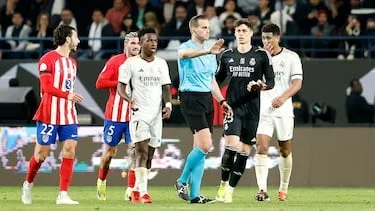
Javier Alberola Rojas has gone from appearing on a dating show to officiating the Copa del Rey final. Such is the remarkable journey of one of LaLiga’s top referees today, a man destined to lead Spanish officiating in Europe. The Spanish Technical Committee of Referees (CTA) has entrusted the Ciudad Real-born official with the crucial Atlético Madrid vs. Real Sociedad match at La Cartuja this Saturday.
This is a referee who sparks plenty of discussion—both for his resilience off the pitch (a health scare nearly forced him into retirement at just 30) and for his skills on it. He recently navigated a league storm after protests over not awarding a penalty for a foul on Mbappé, and now faces his first Copa del Rey final. Many believe it won’t be his last.
Alberola Rojas’s story (born in 1991) doesn’t go unnoticed, whether professionally or personally. At just 26, he earned promotion to La Liga, becoming the youngest referee to officiate in Spain’s top flight. His career has been meteoric, always labeled a high-potential official with a bright future. He has managed that pressure and become a reality—now among the best, as the CTA’s hierarchy and fellow referees often point out. But he hasn’t peaked yet, according to those around him. “He’s the future referee in Spain,” a senior officiating source states. Another source consulted by AS adds, “He’s one of those with the greatest short-term projection. He could be a key figure in the generational change in refereeing.” In other words, someone to take over from Sánchez Martínez, Hernández Hernández, Martínez Munuera… “There’s no doubt he’s the regeneration alternative to the current elite referees,” says another colleague.
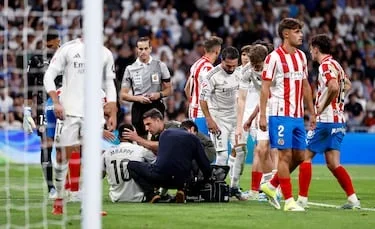
There is great confidence in him, especially due to his evolution and potential. “He’s a physical specimen and highly respected by the clubs,” they conclude. To achieve this, he has refined his refereeing: “He’s possibly the referee who has evolved most in recent years. He has gained composure, calmness in management, and in how he interacts with players. He’s earned respect on the pitch.” Although his approachable style initially clashed—as when Morata got angry over a slight tap on the neck of just two fingers meant to calmly diffuse his protests—he has learned to handle such behaviors, maintaining authority while keeping closeness and connection with footballers.
If there’s one quality most voices consulted by this newspaper agree on, it’s his ability to manage matches and communicate with players. “Authority without excessive prominence,” underscores an authoritative voice. This translates into mastering the game: he relates well with footballers and handles everything on the pitch, noted for his “good judgment in maintaining flow,” avoiding calling minor contacts or reaching for cards easily. “One of his trademarks is that he tends to let play flow more and is less interventionist,” they point out. Another source adds: “He likes to let play develop a lot and raises the threshold for contact.” His approach balances control with freedom.
